.jpeg)
If you have started researching home automation for a new build, you will have come across the letters KNX. It tends to appear in specifications and on product pages without much explanation, which is unhelpful when you are trying to work out whether it matters to you.
It does matter, though not for the technical reasons usually given. KNX is the difference between a home whose controls still work in twenty years and one that depends on a single manufacturer staying interested. This post explains what KNX is in plain terms, how it behaves in a house someone actually lives in, and why it is worth knowing about before your walls close.
What is KNX?
KNX is an open standard for controlling the systems inside a building: lighting, heating, ventilation, blinds and shading, and energy monitoring. Rather than being a product you buy, it is an agreed way for equipment from different manufacturers to understand one another.
The KNX Association was formed in Brussels in May 1999, bringing together three earlier European building control standards. It is recognised as an international standard, and hundreds of manufacturers across the world build equipment to it. You can read the background on the KNX Association's own site.
The practical consequence of "open" is worth spelling out. With a closed system, the manufacturer owns the whole chain: if they discontinue a range, change direction, or stop supporting older equipment, you are left with a house full of controls nobody can service. With KNX, a keypad from one manufacturer talks to a heating actuator from another. If one part is discontinued in fifteen years, an equivalent from a different manufacturer takes its place, and the rest of the house carries on unchanged.
How does KNX work in a home?
A thin control cable runs through the house alongside the ordinary mains wiring, installed while the walls are still open. Every device on that cable, whether a switch, a sensor, a heating valve or a blind motor, has its own intelligence and can respond to what the others are doing.
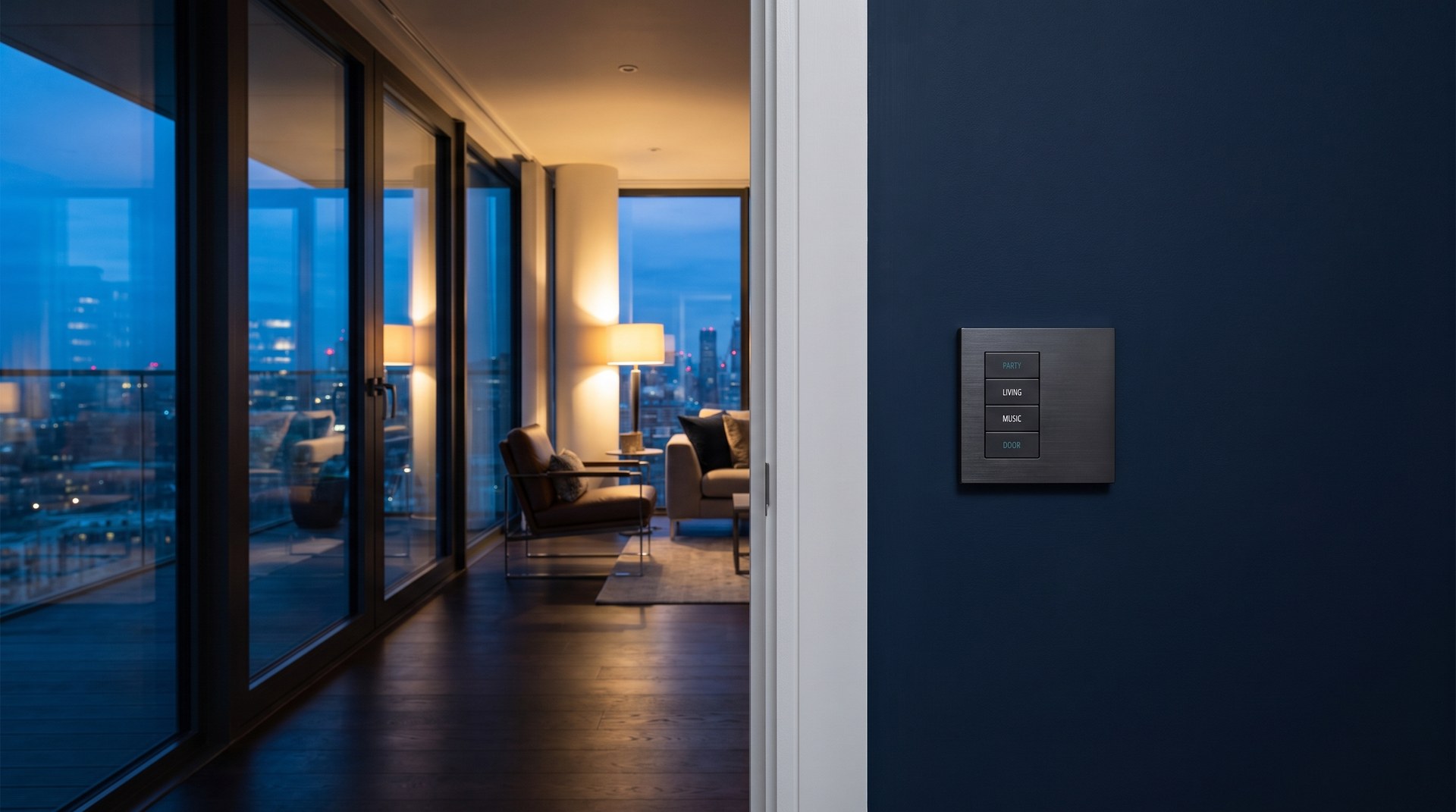
That arrangement is what makes a single button press meaningful. Press one button on the way to bed and the ground floor dims and goes out behind you, the heating settles back for the night, and the blinds draw. None of this requires a central computer to be working, because the instructions live in the devices themselves.
It also explains a quality that is hard to appreciate until you live with it: the controls respond immediately, every time, because they are not waiting on a wireless signal to find its way through a wall. We have written more on why a wired system behaves differently day to day.
Does a KNX home depend on the internet?
Nothing you rely on day to day needs Wi-Fi or an internet connection. The lighting, the heating, the blinds and the scenes all run on the wired network inside the house. If your broadband drops out on a winter evening, the house behaves exactly as it did an hour earlier.
The internet earns its place for the things that genuinely benefit from it: reaching the house from your phone when you are away, and letting us look at a system remotely if something needs attention. Those are conveniences layered on top, not the foundation the house stands on. It is a meaningful distinction, and one that separates built-in control from the wireless switches sold as an easy alternative.
Why does KNX matter for a new build?
Three reasons, and they all come down to time.
The standard outlasts the equipment. KNX has been in continuous use since 1999. Systems installed years ago still run, and can still be extended with equipment made today. A house is a thirty-year proposition at least, and the control system should be judged on the same horizon as the wiring and the plumbing rather than as a consumer purchase.
It grows with the project. A system can begin with lighting and heating and take on blinds, shading or energy monitoring later, without tearing out what is already there. On a self-build where the budget evolves between first fix and completion, that flexibility is worth a great deal. Deciding what to include now and what to leave room for is the substance of getting the specification timing right.
You are not tied to one company. Because the standard is open, no single supplier holds the keys to your home. Any KNX-qualified professional can work on the system in future. For a homeowner, that is the difference between an asset and a dependency.
Can a KNX system be changed once it is installed?
Yes, and this is where expectations are often set wrongly. A common assumption is that a house like this is fixed at handover and any change means calling someone out. That has been true of a good deal of traditional automation, where every adjustment meant booking an integrator and waiting.
The cable is the permanent part. What the house does with it is not. Scenes can be re-timed, brightness levels changed, and rooms reorganised as the way you use the house changes: a study that becomes a bedroom, a child who starts going to bed later, a kitchen that needs a brighter setting on winter mornings. With Baulogic, you can edit your own Smart Events whenever you want to, without a specialist involved.
How does Baulogic use KNX?
Every Baulogic system is built on KNX, and configured off site before it reaches the property. The design work, the programming and the testing all happen before delivery, so what arrives on site is a finished system rather than a box of parts waiting for a specialist.
That changes who installs it. A qualified electrician runs the cable at first fix and connects the system at second fix, working from a cabling plan drawn up for the specific property. There is no separate programming visit and no specialist trade sitting in the middle of your programme. At Maple Barn, a four-bedroom new build delivered with Kaybee Developments, the automation went in without an integrator ever attending site, which you can read about in the project case study.
The result for whoever lives there is a house that behaves well from the first day, built on a standard that will still be understood long after the fashions in home technology have moved on.
Work backwards from the house rather than forwards from the technology. You are choosing something that sits in the walls for the life of the building, so the question worth asking is not which system does the most today, but which one will still be serviceable, extendable and yours in twenty years.
That is the case for an open standard, and it is why every system we build runs on KNX. If you are planning a new home and want to know what this looks like in practice, our guide for self-builders covers how it fits into a build, and what a KNX home means for your self-build takes it further.
More Insights