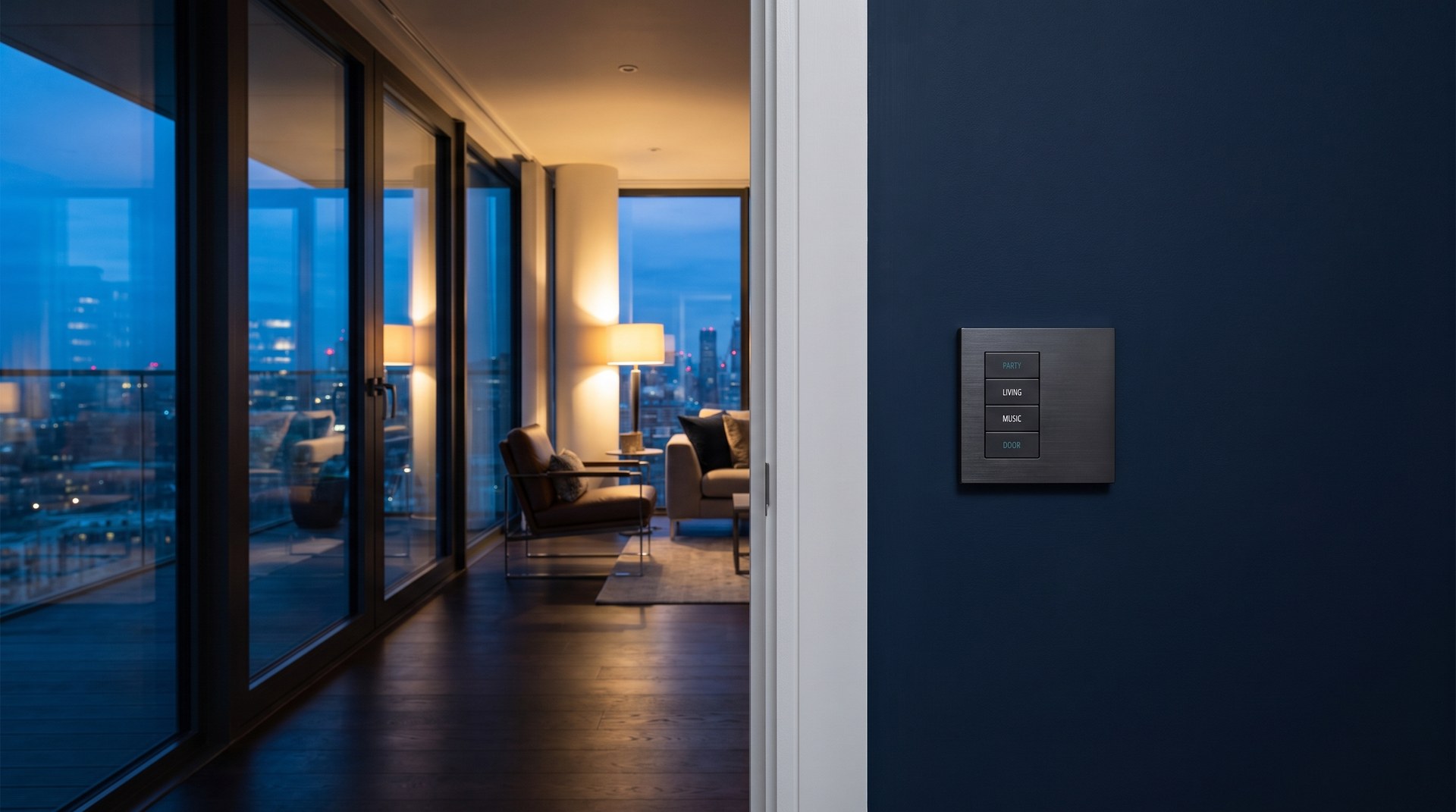
A buyer walks into a show home, sees a keypad by the door, and quietly files the house under the same heading as the wireless plug they bought last year and stopped using. Nothing in the viewing corrects that impression, and the technology you paid to install gets valued accordingly.
This is the most expensive misunderstanding in selling a connected home, and it is entirely fixable. This post covers what buyers actually think home automation is, why the gap costs a developer real money, and how to close it without turning a viewing into a lecture.
What do buyers think home automation means?
Usually one of two things, and neither is what you have installed.
The first group pictures voice speakers, video doorbells and app-connected bulbs: things bought individually, added to a house that already existed, working some of the time. The second group pictures the opposite extreme, a wall of screens and an expensive specialist on call, which they associate with difficulty and expense.
Very few arrive with an accurate picture of a system designed into the building, wired during construction, and operated from one control by anyone in the household. That idea is simply not in most people's experience, so they map what they are shown onto the nearest thing they do know. For most buyers, the nearest thing is a consumer device that disappointed them. The distinction between the two is worth understanding in its own right, and our post on the difference between a smart home and home automation sets it out.
Why does the knowledge gap cost a developer money?
Because a buyer cannot value something they have misidentified.
If the automation reads as a set of consumer devices, the buyer prices it as consumer devices: a few hundred pounds of equipment they could have added themselves. Every bit of the difference between that and an integrated system designed into the fabric of the house is invisible, and invisible things do not contribute to what someone will pay.
There is a second, quieter cost. Buyers who associate the category with unreliability do not treat the technology as neutral, they treat it as risk. A feature intended to make the home more desirable starts working against the sale, prompting questions about maintenance and what happens when it goes wrong. Either way the specification underperforms, not because it is inadequate but because it was never accurately understood.
Can the gap work in your favour?
It is one of the strongest openings available to you, precisely because expectations start low.
When a buyer who expects consumer devices encounters a system that responds instantly, works from one control and was built into the house, the reaction is disproportionate. You are not making a small improvement on what they imagined; you are correcting a misconception, and that lands far harder than a feature list. Buyers remember the moment they realised a thing was better than they assumed.
Getting that reaction depends on drawing the contrast explicitly rather than hoping it is inferred. Four points do most of the work. It is wired into the building, so nothing you rely on day to day needs Wi-Fi or an internet connection. It is part of the house rather than plugged into it. It runs from one control rather than several apps. And it is built on an open international standard, so it stays serviceable for decades rather than until a platform is discontinued.
How should buyers be educated before the viewing?
Quietly, and in the places they are already looking.
On the development website, give connected living its own section written in plain language, describing what living in the house is like rather than what the system contains. Short video of the technology in ordinary use does more than any paragraph: a kitchen coming up to a working brightness in the morning, blinds handling low sun in the afternoon.
In the brochure, a simple side-by-side does the heavy lifting. One column for the fragmented version buyers already know, with several apps, patchy connections and a short life. One column for the integrated version, with one control, wired reliability and a lifespan measured against the building. Buyers grasp the distinction faster from that layout than from any amount of prose, and it arms them to explain the difference to a partner who did not attend the viewing.
What is the most effective moment to correct the misunderstanding?
The viewing, without question. Everything else is preparation for it.
A single demonstration outperforms every brochure you will ever print, because the buyer experiences the response rather than reading a claim about it. One press that takes a living room from bright working light to a settled evening tells them more in three seconds than a page of copy. Our guide to using home automation in show homes covers how to set that up so it lands.
The discipline is restraint. Demonstrating everything the system can do reintroduces exactly the impression of difficulty you are trying to remove. Three moments, chosen because they are recognisable from daily life, will do more than a full tour of the capability.
Afterwards, send something they can read at home. Buyers make decisions with people who were not at the viewing, and a clear homeowner guide lets them carry the explanation back rather than reconstruct it. We provide documentation written for homeowners rather than installers, and making it available during the sales process reassures buyers that living with the system will be straightforward.
What does the sales team need?
Less than most developers assume, but it has to be the right material.
They do not need technical training. They need confident answers to the three questions that come up in almost every viewing: is this the same as Alexa, will it be hard to use, and what happens when it breaks. The answers are that it is a different category of thing, wired into the house rather than added to it; that it is designed so anyone can use it without being shown; and that if something does go wrong, the homeowner contacts Baulogic directly, and remote diagnostics mean most queries are resolved without anyone attending.
A one-page briefing covering those three, rehearsed until it sounds natural, is worth more than a product manual nobody opens. The tone matters as much as the content: buyers are happy to be told something they did not know, and unhappy to be made to feel they should have known it already.
The gap between what buyers think home automation is and what you have actually built is where the value leaks out. Close it and the specification does the job you paid for; leave it open and a considered piece of infrastructure gets priced like a device from a catalogue.
Closing it costs very little: plain language on the website, one honest comparison in the brochure, three rehearsed answers for the sales team, and one good demonstration at the viewing. For what buyers are expecting in the first place, see what premium buyers expect from new-build technology, or our developer guide for how this fits a scheme.
More Insights