A housebuilder delivering 40 units across a single premium scheme faces the same specification decision 40 times over. Choose a control system that has to be designed and programmed plot by plot, and the cost and the risk multiply with every home. Choose one that repeats, and the fortieth install looks much like the first.
That is the practical case for home automation for property developers working at scale: the system has to be repeatable, not bespoke. A modular, pre-configured setup lets the same specification drop into house type after house type, with a standard electrician installing it against the build programme rather than a specialist returning to each plot.
This post covers why repeatability matters on a multi-plot development, what makes a system repeatable, and how a modular approach handles the variation between house types without starting from scratch each time.
Why does repeatability matter on a multi-plot development?
On a single home, a one-off control system is an inconvenience. On a development of 20 or 40 units, it is a cost and programme problem that compounds. Every plot that needs its own design, its own programming visit, and its own commissioning adds labour, adds time, and adds another point where something can go wrong after handover.
Repeatability removes that multiplication. When the same specification applies to every plot of a given house type, the developer prices it once, briefs the M&E contractor once, and gets a predictable result on every unit. The cost per plot stops drifting, and the callbacks that eat into margin after completion become far less likely.
What makes a home automation system repeatable across plots?
Three things make a system repeatable. It arrives pre-configured, so the control logic is set before it reaches site. It is modular, so the same building blocks cover different requirements. And it installs with a standard electrician, so no specialist has to visit each plot to program it.
Baulogic systems are pre-configured and modular for exactly this reason. The control panel is built and configured off-site, delivered sealed, and connected during first and second fix using push-fit connections. The electrician wiring plot 1 follows the same schedule on plot 40, and the system behaves the same way in each.
How does a modular system handle different house types?
Most developments are not one house repeated. They are a handful of types: a two-bedroom apartment, a three-bedroom terrace, a four-bedroom detached. A modular system covers that range by adding or removing modules rather than redesigning the system each time.
A smaller unit might control lighting, heating, and security. A larger one adds blinds, multi-zone underfloor heating, and more keypads. The underlying system is the same in both. What changes is the number of modules and the wiring schedule, not the design or the programming. That is what lets a developer standardise across a scheme while still matching each house type to its specification.
What does pre-configuration change for the build programme?
A pre-configured system is ordered against the build programme and arrives ready to install. There is no programming stage on site, and no wait for a specialist integrator to become available between first and second fix. On a phased development, that predictability is worth as much as the cost saving.
- The panel is configured off-site and delivered to match second fix, not weeks after it.
- The site electrician installs it as part of the normal electrical package.
- Each phase repeats the last, so programme risk does not grow as the scheme scales.
The system fits the construction sequence instead of fighting it, which is the difference between a specification that scales and one that slows every plot down.
How does this compare with integrator-led systems?
Systems such as KNX, Crestron, and Control4 are capable, but most are designed around a specialist integrator who programs each installation. On a single prime home that is manageable. Across a development, it means booking an integrator for every plot, and tying the handover of each unit to that integrator's availability and after-sales support.
The structural difference is where the configuration lives. An integrator-led system is programmed per project, on site. A pre-configured modular system carries its configuration from the factory, so the specialist step is removed from the plot entirely. For a developer, that turns control from a bespoke trade into a repeatable line on the electrical schedule.
What repeatable automation looks like on site
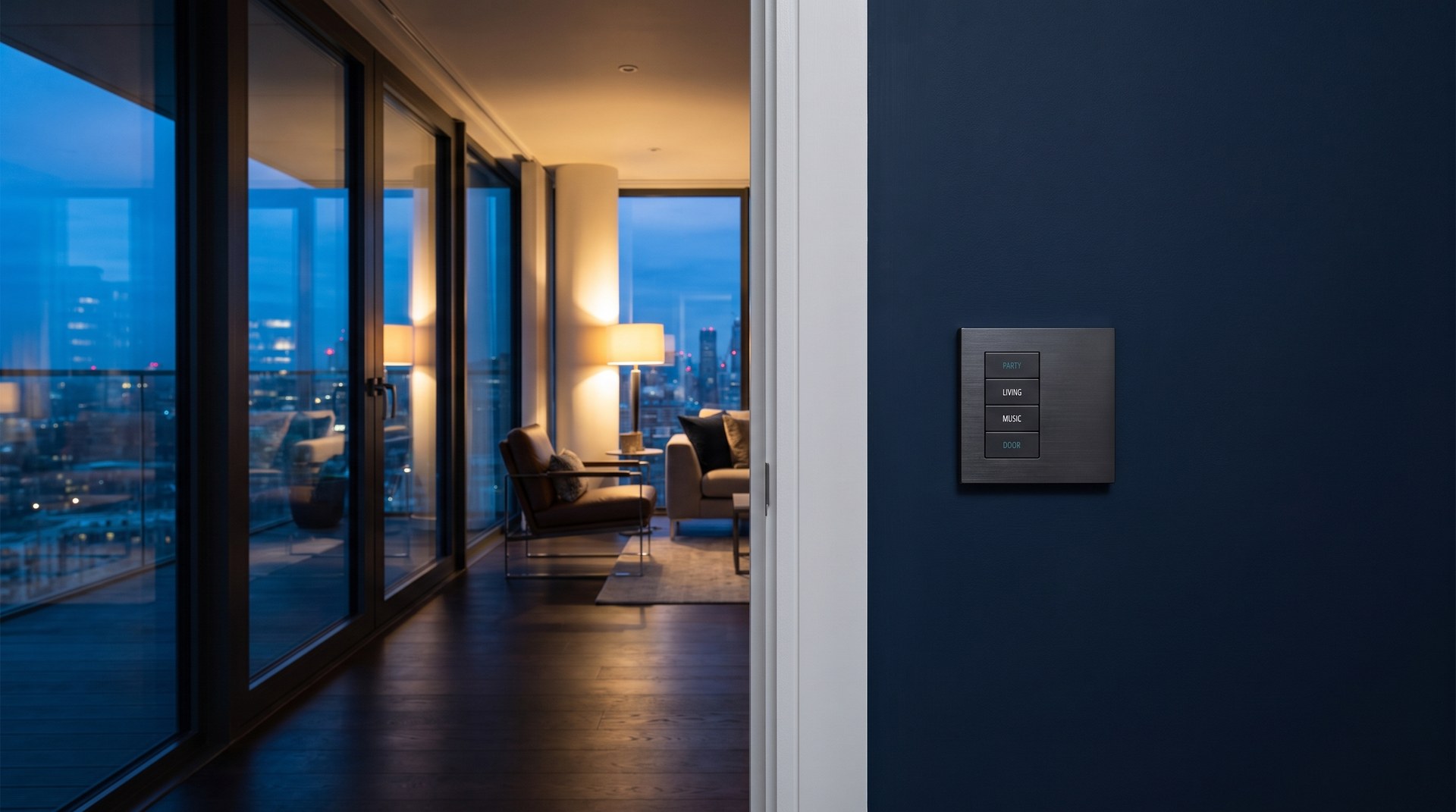
At Maple Barn, a four-bedroom new build for Kaybee Developments, one hardwired setup controls heating, lighting, blinds, and security through multi-functional keypads in each room. It was delivered pre-configured and installed by the site electrician, with scenes for goodbye, goodnight, welcome, and good morning set before it arrived.
The point for a developer is not the single house. It is that the same pre-configured, modular setup can be specified again on the next plot and the next scheme, with the same install method and the same result each time. That is what makes it a specification decision rather than a bespoke project.
At scale, the control system that wins is the one that repeats. A modular, pre-configured setup lets a developer price the specification once, hand it to a standard electrician, and get the same outcome on every plot without a specialist returning to site. The bespoke alternative multiplies cost, programme risk, and callbacks with every unit.
If you are specifying a scheme now, the practical next step is to treat home automation as a repeatable part of the electrical package from the first plot. Our guide for property developers sets out how the system fits a multi-plot programme.
More Insights