A property developer planning a premium schemetoday is briefing for a buyer pool that has changed shape over the past fiveyears. Buyers spending £700,000 or more on a new build now expect integratedlighting, climate, and security control as part of the specification, not as anupsell during the sales process.
The question is no longer whether to includehome automation. It is which system fits the build, the buyer profile, and thecommercial model. Hardwired, pre-configured home automation answers thatquestion across the range of project sizes UK developers actually work on, froma single refurbishment in central London to a small premium scheme on the edgeof a city.
This post sets out why home automation addsvalue for buyers, how that value translates into commercial returns fordevelopers, and why a scalable hardwired system works across build sizeswithout a separate specification for each project.
The buyer expectation at the premium end has shifted
Five years ago, home automation in a new build was a differentiator at the premium end. A developer specifying integrated lighting, multi-zone heating control, and motorised blinds could position those features as part of what set the property apart from comparable homes.
That position has narrowed. Premium new builds at the £700,000 and upwards price point now routinely include some form of integrated home control, and buyers researching the market arrive at viewings already expecting to see it. The differentiator is now the quality of the system, how it integrates with the rest of the M&E specification, and how much control the homeowner retains after handover.
Buyers at this end of the market are also better informed. They read about KNX, Loxone, Lutron, and Crestron before they walk into a show home, and they ask specific questions about whether the system relies on WiFi, whether it integrates with the heat pump and MVHR, and whether they need to call a specialist back in to change a lighting scene.
How home automation adds value buyers feel daily
Lighting and shading control across the home
Multi-zone lighting control is the feature most buyers register first, because it is the one they experience every time they walk through a room. A pre-configured system controls each lighting circuit independently, supports dimmable and colour-temperature changes where the fixtures allow, and integrates with motorised blinds and curtains to manage natural light through the day.
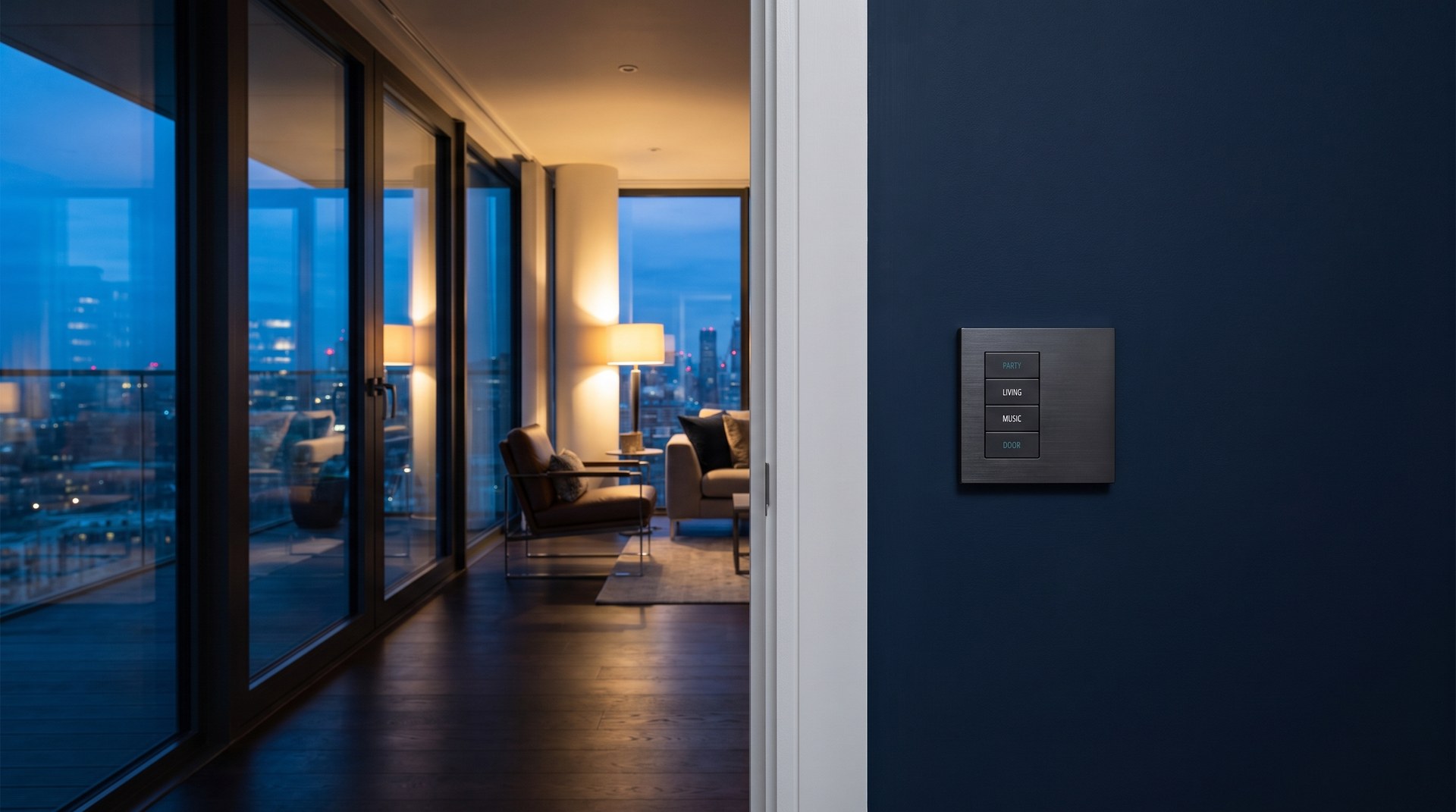
Pre-set scenes for waking, working, dining, and goodnight let a homeowner reset the lighting and shading state of the whole house from a single keypad or app, without needing to touch individual switches in each room. At Maple Barn, a four-bedroom new build by Kaybee Developments, multi-functional keypads in each room run scenes for goodbye, goodnight, welcome, and good morning across all bedrooms, the kitchen, and the living spaces.
Heating and energy management
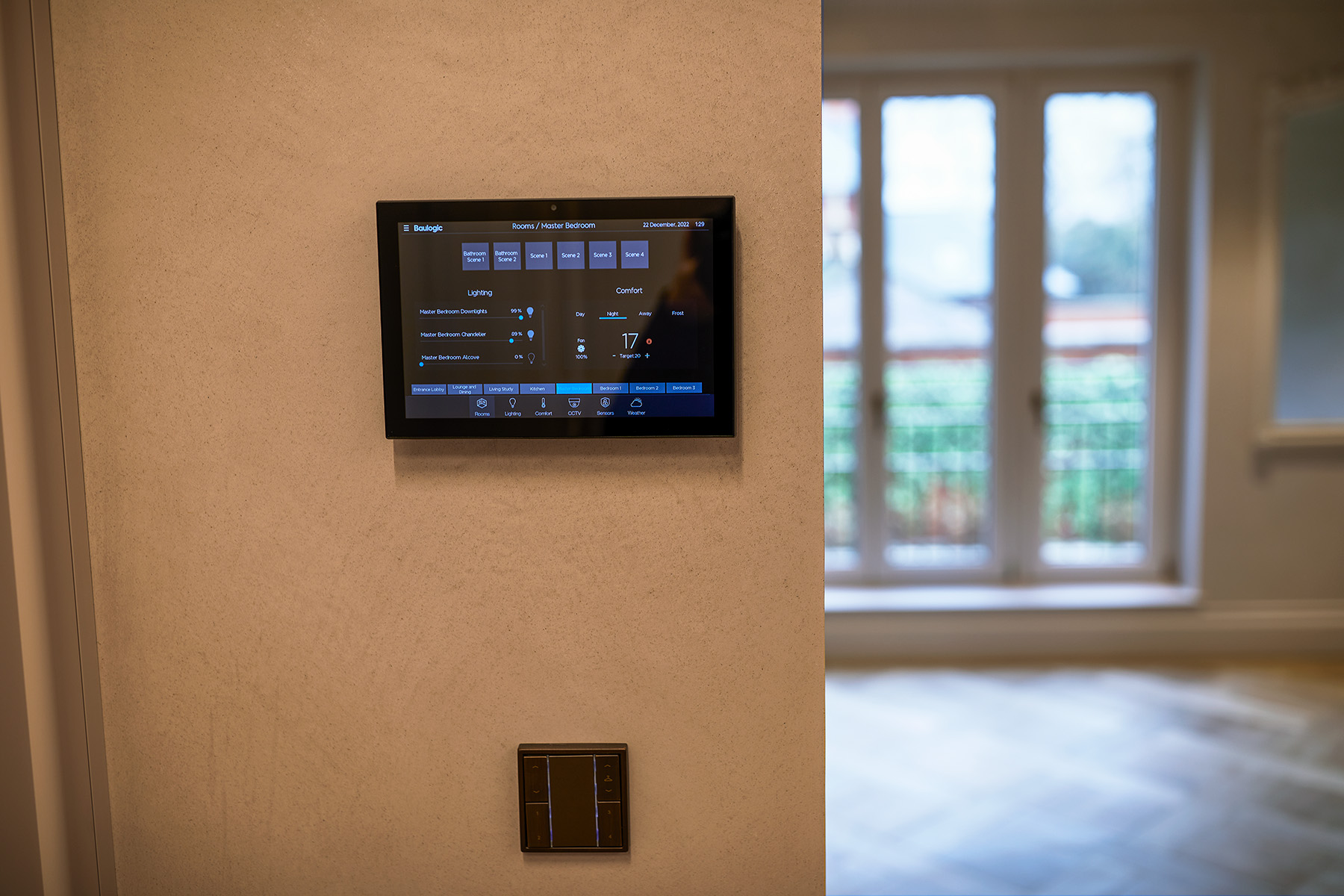
Heating and energy control is where home automation pays back hardest for buyers in running costs. Multi-zone underfloor heating, electric UFH in ensuites, and towel rails can all be controlled from a single interface, with scheduling that follows the homeowner's actual routine rather than the rigid windows of a basic programmable thermostat.
When the system integrates with an air source heat pump, MVHR, and solar PV with battery storage, the heating and ventilation work together rather than in isolation. Maple Barn manages roughly 500 temperature control events per week across its zones, with the home running on an air source heat pump, solar PV with battery, and a balanced MVHR system. That level of control is what produces measurable savings on running costs and supports a strong EPC rating, both of which buyers ask about during viewings. We cover the EPC link in more detail in our guide to how hardwired home automation improves EPC ratings.
Security as a built-in layer
Security is the third area where home automation gives buyers something they can see in daily use. CCTV, motion sensors, door and window contacts, and smoke detectors with remote alerts can all be wired into the system during the standard electrical first fix and managed through the same app and keypads as lighting and heating.
At the Kensington penthouse, the system manages security cameras alongside DALI-2 lighting and Daikin heating and cooling, all from one interface. Hardwired security is more reliable than a wireless retrofit, and integrating it with the rest of the home control means the buyer is not juggling three or four separate apps after they move in.
How that buyer value translates into developer returns
Higher asking prices supported by spec
Buyers will pay for specification they can see and use. A premium new build with integrated home automation as part of the M&E package supports a higher asking price than an equivalent home without it, because the system is one of the features the agent leads with during viewings. The home automation specification also appears in the marketing brochure and the listing, and it gives the agent something specific to point to when justifying the price.
Faster sales at the premium end
Premium new builds with weak specifications sit on the market longer. Buyers at the £700,000 and upwards level are comparing several similar homes and looking for reasons to choose one over another. A home automation system that is already installed, commissioned, and demonstrable at the viewing stage gives the buyer fewer reasons to keep looking. Sales cycles shorten when the spec answers the questions the buyer was going to ask anyway.
Reduced post-handover callback liability
Home automation systems that depend on a specialist integrator create an ongoing support liability for the developer. If the system needs reprogramming because the homeowner wants to add a lighting scene or change a heating zone, and the integrator who set it up is no longer available, the developer fields the call.
Pre-configured systems remove that liability. The homeowner customises lighting scenes, heating schedules, and security routines through the app or wall interface without needing to call anyone back in. For the developer, this means fewer post-handover queries, no specialist callouts to schedule and pay for, and a cleaner end to the relationship with the buyer once the warranty period closes.
Why hardwired, pre-configured systems scale across build sizes
Single-unit refurbishments
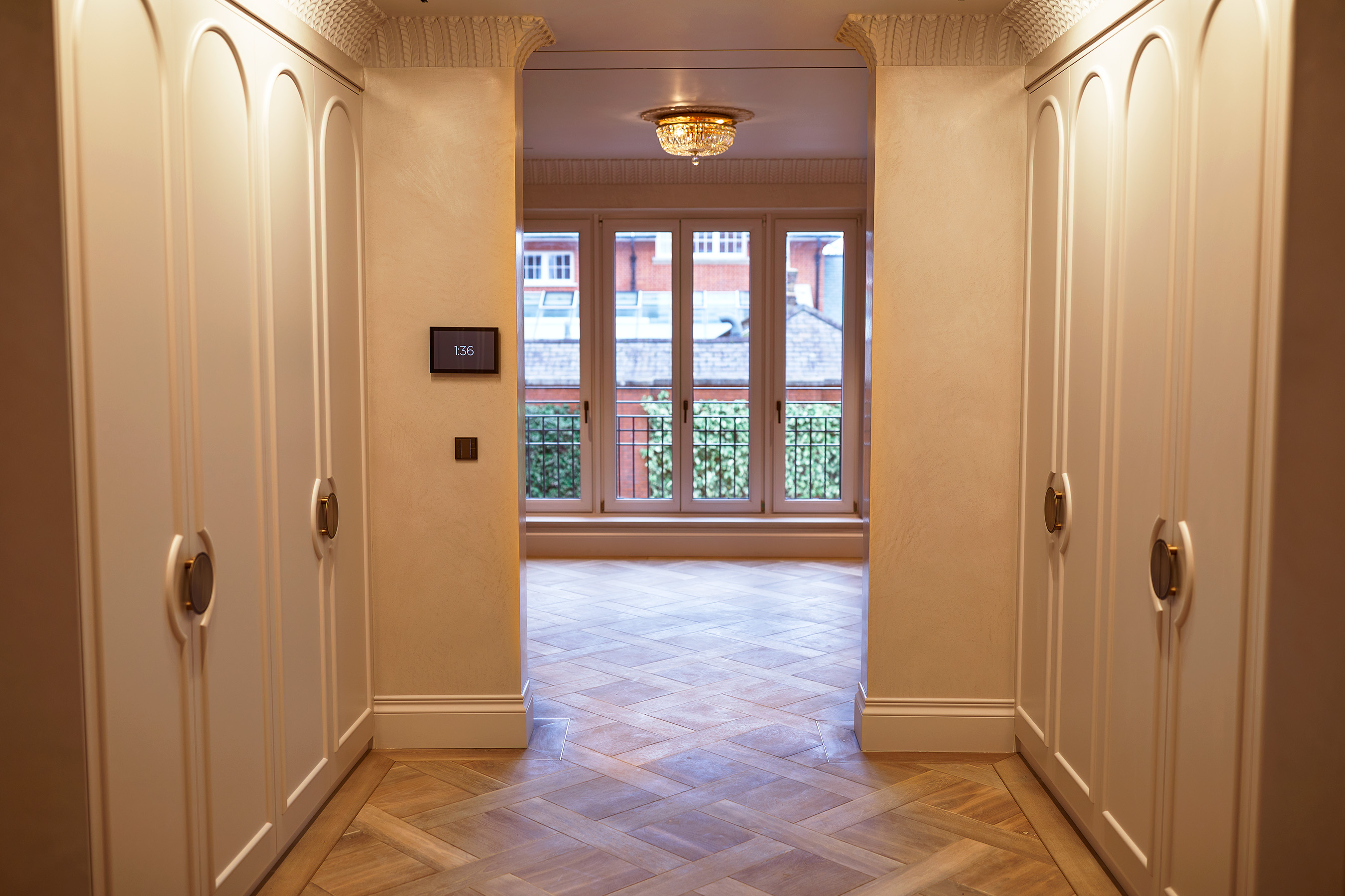
A major refurbishment of a single apartment or townhouse is the smallest project where hardwired home automation makes sense. The Mayfair apartment, a two-bedroom refurbishment in central London, was specified with control of lighting, heating, cooling, blinds, and security, all installed by the client's own electrician during the second fix. The system arrived as a sealed panel with push-fit plugs, pre-configured to the room layout and the M&E drawings, and was commissioned without a separate integrator visit.
Small premium schemes
For developers building three to ten premium homes on a single site, a pre-configured system gives every plot the same baseline specification without the cost of designing each one from scratch. The same modular product, scaled to the room count and fixture schedule of each plot, ships to site as separate panels for each home.
Each plot gets its own pre-commissioned system, the electricians on the standard contract install all of them, and the developer briefs the buyer on the same control interface across every home in the scheme. This consistency makes the spec easier to market and easier to support.
Larger multi-unit developments
On larger schemes of 10 units and upwards, the case for a scalable, pre-configured system is stronger again. A specialist integrator approach does not scale economically across 20 or 30 plots, because each home requires its own programming, commissioning, and post-handover support window. The cost compounds with every additional unit.
A pre-configured modular system multiplies cleanly. The same product specification covers every plot, the panels are built off-site to the same standard, and the electricians installing them follow the same wiring diagram across the site. The developer's M&E consultant specifies one system once, not 20 times.
Specifying home automation early in the build programme
Home automation specified late costs more than home automation specified early. Once the M&E drawings are finalised and first fix wiring is on site, retrofitting structured cabling and a control panel into the design is expensive and disruptive.
The right point to specify is at RIBA Stage 3 or early Stage 4, alongside the lighting, heating, and security designs. The home automation specification informs the cable schedules and panel locations before first fix, and the panel itself arrives on site pre-configured and ready to commission during second fix.
For developers briefing M&E consultants, the practical step is to name the home automation system as part of the original specification, not as a variation to be priced later. This keeps the cost predictable, the build programme clean, and the spec consistent across every plot in the scheme.
Home automation now sits in the same category as MVHR, air source heat pumps, and solar PV for premium new builds: a specification line that buyers expect to see and that supports the asking price of the home. The question for developers is which system can be specified once and rolled out across every project type the business handles.
A hardwired, pre-configured modular system meets that requirement across build sizes from a single refurbishment to a multi-unit scheme. The next step for any developer planning a premium scheme is to bring home automation into the M&E brief at RIBA Stage 3, alongside the heating and lighting specifications, rather than treating it as a separate workstream.
More Insights