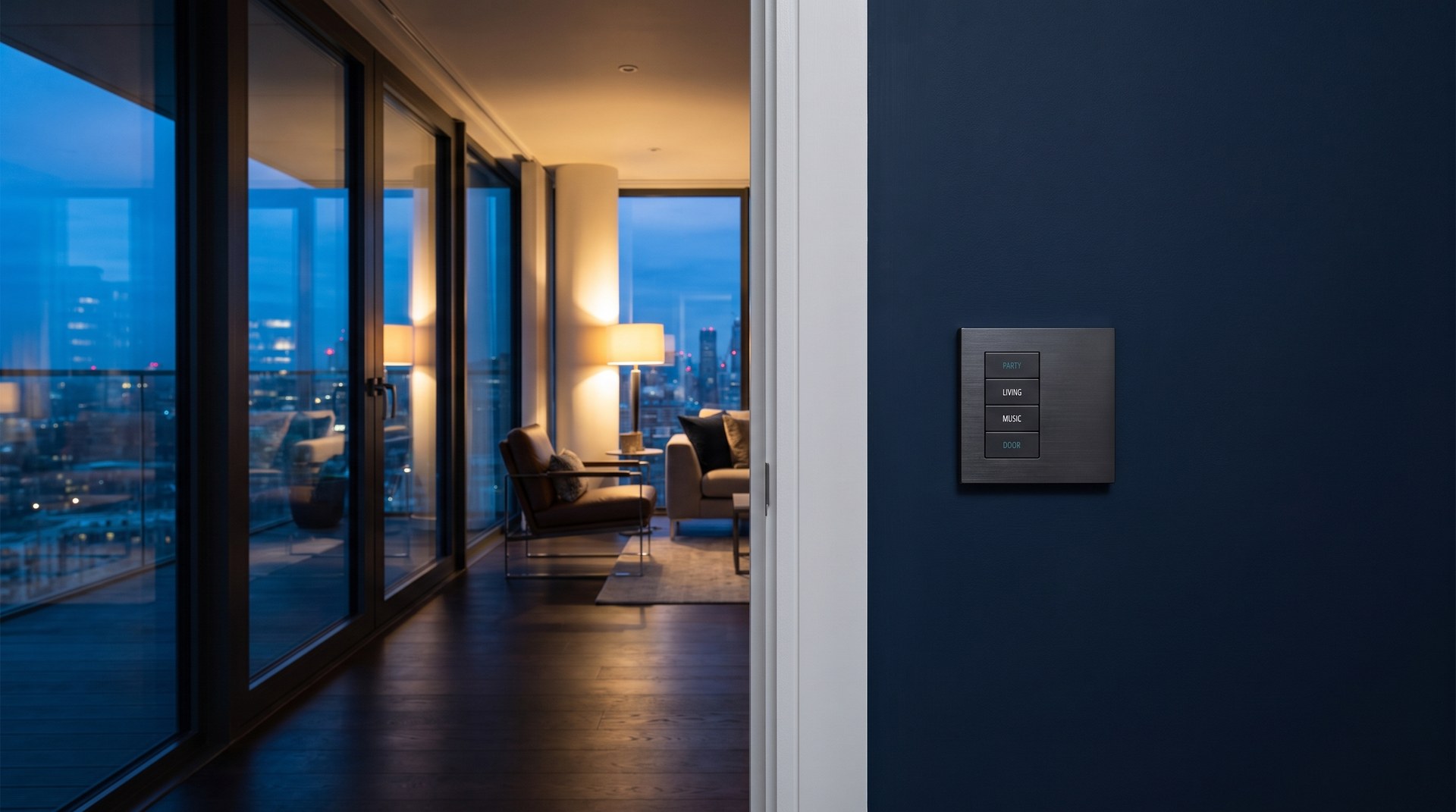
A property developer planning a £4M new build in Surrey faces a decision early in the M&E spec: include home automation or leave it for the buyer to retrofit. The retrofit route is rarely cheaper once you factor in disruption, redecoration, and the gap between handover and a finished system.
The harder question is which type of home automation to specify. Most established systems require a specialist integrator on site for commissioning, ongoing changes, and any post-handover support. That introduces a dependency the developer has no control over once the buyer moves in.
A pre-configured, hardwired system removes that dependency. The hardware is built and programmed off site, delivered as a sealed panel, and installed by the same electrician handling the rest of the first and second fix. This guide walks through how that works in practice, from initial specification through to post-handover support.
What pre-configured means in this context
Pre-configured home automation systems arrive on site already wired internally, already programmed for the property's specific layout, and ready to connect to the building's lighting circuits, heating, blinds, and security infrastructure. The configuration work, deciding which keypad button does what, how scenes are structured, how zones are grouped, happens before the panel leaves the factory.
This differs from the standard residential developments model for premium home automation, where an integrator visits the site multiple times during construction to wire, programme, and commission a bespoke system. With a pre-configured approach, the programming is locked in before first fix begins, and the electrician installing it does not need to understand the underlying logic.
The system is also modular. If a project adds a study or splits a room late in the build, the relevant module can be added without rewriting the rest of the configuration.
Why developers are moving towards turnkey home automation
There are three practical reasons developers on premium schemes are shifting towards turnkey home automation rather than traditional integrator-led installations.
The first is programme certainty. Integrator-led systems depend on a third party attending site at specific points in the build. If they slip, the build slips. A pre-configured panel sits in stores until the electrician needs it.
The second is cost predictability. Bespoke programming is charged by the day and grows with revision rounds. A pre-configured system has a fixed scope priced before the order is placed.
The third is post-handover liability. Once a buyer takes possession, any issue with a bespoke system routes back through the integrator, who routes it back through the developer. A homeowner-customisable system removes most of that loop.
When to specify the system in the build programme
The right point to lock in the specification is during M&E design development, before first fix begins. Earlier is better, because the lighting circuit layout, heating zoning, and blind motor positions all need to align with what the system will control.
Specifying late, after first fix has started, is still workable but limits flexibility. The system will adapt to the wiring already in place rather than the other way round, which usually means fewer scene options and less granular zoning.
For a typical four-bedroom new build, the specification work involves agreeing the room-by-room schedule of what is controlled, the keypad locations and engraving, and the high-level scene logic. This is a single design session in most cases, followed by a written specification the M&E consultant signs off.
First fix: what the electrician does
During first fix, the electrician runs the cabling required by the system specification. This is conventional containment and cable work, no different in technique from a standard premium electrical install.
The cabling required typically includes:
- Bus cable to each keypad location, run back to the central panel position
- Switched live and neutral feeds to each lighting circuit through the panel
- Low-voltage cabling to blind motors, valve actuators, and door contacts
- Network cable to the panel location for app and touchscreen connectivity
No specialist termination is required during first fix. The cables are pulled, labelled, and left ready for second fix. The electrician does not need prior experience with home automation integration to complete this stage.
At Maple Barn, a four-bedroom new build by Kaybee Developments, this approach allowed the main contractor's electrician to handle the full automation cabling without bringing in a specialist subcontractor.
Second fix: panel installation and termination
The pre-configured panel arrives sealed, with each external connection labelled and fitted with push-fit plugs. The electrician mounts the panel in the location specified in the M&E drawings, typically a plant room, utility cupboard, or dedicated comms riser.
Termination is push-fit. Each labelled cable from first fix plugs into the corresponding port on the panel. There is no programming, no commissioning visit, and no specialist tool required.
Keypads and touchscreens are mounted and connected during second fix using the bus cable run during first fix. Engraving, button mapping, and scene assignments are already configured.
At the Mayfair apartment refurbishment, the panel was delivered pre-configured in a sealed unit and installed by the client's own electrician. Lighting, heating, cooling, blinds, and security were all live at second fix completion, with no integrator visit required.
Testing and commissioning
Because the system is pre-configured, commissioning is reduced to verification rather than programming. The electrician powers up the panel, confirms each circuit responds, and walks through the scenes with the site manager.
A typical four-bedroom property takes half a day to verify. If a circuit does not respond, the issue is almost always a wiring fault at the device end, which the electrician diagnoses and corrects in the same way they would on any other circuit.
There is no software to configure on site. The panel does not need internet access to function. The system runs on its own bus and does not depend on WiFi or cloud services for core control.
Handover to the buyer
At handover, the buyer receives a working system with documentation covering the room-by-room control schedule, the scene logic, and instructions for the app and touchscreen interface.
Because the system is homeowner-customisable, the buyer can rename scenes, adjust scene contents, reassign keypad buttons, and create new automations themselves. They do not need to call the developer or a specialist integrator to change how the goodnight scene works or to add a new lighting preset.
This matters for developers because the most common post-handover complaint with bespoke home automation is the buyer wanting changes the developer no longer has any practical route to deliver. With a homeowner-customisable system, that route exists by default.
For voice control, the system integrates with Alexa where the buyer wants it, as it does at the Mayfair apartment. This is optional and does not affect core functionality.
Post-handover support and developer liability
Pre-configured systems reduce, but do not eliminate, post-handover support. The categories of issue that can still arise are:
- Hardware faults on individual modules, covered by warranty and replaced by an electrician
- Wiring faults that emerge after first occupation, handled the same way as any other electrical defect
- Buyer requests for changes beyond what the homeowner interface allows
For the first two, the developer's standard defects process applies. For the third, the homeowner can either configure the change themselves through the app or commission additional work directly with Baulogic, which keeps the developer out of the loop.
This is structurally different from integrator-led systems, where almost any post-handover change routes through the original integrator, often through the developer, and often at unpredictable cost.
How this compares to integrator-led alternatives
Property developer technology decisions on premium schemes typically come down to a choice between pre-configured systems and integrator-programmed systems built on platforms like Crestron, Control4, or KNX.
The structural differences are:
- Programming location. Pre-configured systems are programmed off site before delivery. Integrator-led systems are programmed on site during construction.
- Installer requirement. Pre-configured systems are installed by any competent electrician. Integrator-led systems require a specialist trained on the specific platform.
- Post-handover customisation. Pre-configured systems allow homeowner changes through the app. Integrator-led systems typically require the integrator to return for changes.
- Programme dependency. Pre-configured systems do not require a third party on site at specific build stages. Integrator-led systems do.
There are projects where an integrator-led system is the right answer, particularly where extensive AV integration is part of the spec. Baulogic is not an AV company and does not compete in that space. For lighting, heating, blinds, and security on premium residential developments, the pre-configured approach is structurally simpler.
A worked example: four-bedroom new build
To put numbers around the process, consider a typical four-bedroom new build valued at around £1.5 million.
Specification work: one design session during M&E development, around four to six weeks before first fix begins. Output is a written room-by-room schedule and panel configuration.
First fix: bus and power cabling pulled by the main contractor's electrician as part of the standard electrical first fix. No additional labour days specifically for the automation system.
Panel delivery: panel arrives sealed roughly two weeks before second fix.
Second fix: panel mounted and connected, keypads and touchscreens installed. Adds approximately one to two days to the second fix programme.
Commissioning and verification: half a day at the end of second fix.
Handover: included in the standard buyer walkthrough.
Total build programme impact is typically two to three days of electrician time beyond what a standard premium electrical install would require, with no third-party site visits.
The practical case for pre-configured home automation systems on premium residential developments comes down to control. The developer controls the specification, the programme, and the cost, because the variables that usually sit with a third-party integrator have been removed from the build.
For developers currently specifying integrator-led systems, the question worth asking on the next scheme is which parts of the post-handover support burden could be eliminated by moving the programming off site. For developers not currently specifying any home automation, the question is whether the homes are positioned in a market segment where buyers now expect it as standard.
The next step on a live project is a single design session against the M&E drawings, ideally before first fix begins. That session produces a fixed specification, a fixed price, and a fixed delivery date for the panel.
More Insights