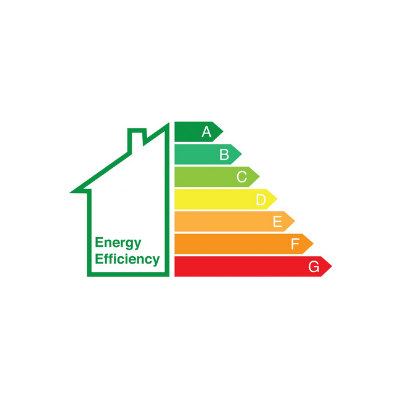
EPC ratings on new-build housing are doing more work in 2026 than they did five years ago. They affect mortgage availability under green lending criteria, they sit on sales particulars where buyers compare directly between developments, and they feed into the trajectory towards Future Homes Standard compliance.
For developers and custom builders working in the £700,000+ segment, an A or high B rating is increasingly the expected outcome rather than a marketing line. The fabric, the heat pump, the MVHR, and the PV array do the heavy lifting. What is less well understood is the role hardwired home automation plays in protecting that rating in practice, and where it earns explicit credit in the SAP calculation itself.
This post is for UK property developers and custom home builders who want to understand how a pre-configured, hardwired control system interacts with EPC outcomes on premium and ultra-prime residential schemes.
What the EPC actually measures
An EPC rating is generated from a SAP calculation that models the energy performance of the dwelling as designed. It considers the fabric, the heating and hot water system, ventilation, lighting, renewables, and a set of fixed assumptions about how the home will be used.
The rating itself is a modelled output, not a measurement of how the home performs once occupied. This is a known limitation, and the regulatory direction with SAP 11 and the Home Energy Model is moving towards better representation of in-use performance, including the role of controls.
For a developer, two things matter. First, what the SAP calculation explicitly credits today. Second, what determines whether the finished home performs in line with its design rating once handed over.
Where home automation earns credit in SAP today
SAP gives explicit credit for several control-related items that a properly specified home automation system delivers as standard.
Heating controls are the most direct example. SAP recognises time and temperature zone control, weather compensation, and load compensation. A home with full multi-zone control, where each room or zone has its own programmable thermostat communicating with the heat source, scores better than one with a single thermostat governing the whole house or a single floor.
For homes with heat pumps, this matters more than it did with gas boilers. Heat pumps run most efficiently at lower flow temperatures over longer periods, and they are sensitive to how zoning and setback are handled. A control system that manages zone-by-zone scheduling, integrates with weather compensation, and coordinates with hot water demand directly affects the SAP-recognised efficiency of the system.
Lighting is the other clear area. SAP credits the proportion of fixed lighting that is low-energy and, in newer methodology, the use of lighting controls that reduce consumption. Daylight-linked control, presence detection, and zonal switching all contribute. A DALI-2 lighting backbone managed through the automation system makes these features available across the whole home rather than in isolated rooms.
Mechanical ventilation with heat recovery is credited based on specific fan power and heat recovery efficiency. Home automation does not change those headline figures, but it does enable demand-based ventilation control linked to CO2 and humidity sensors, which keeps the unit operating closer to its design point rather than at fixed flow rates.
Where home automation protects the rating in practice
The bigger contribution is in the performance gap. Homes routinely fail to achieve their modelled EPC ratings in occupation, often by 20% or more, and the reasons are usually behavioural and operational rather than fabric-related.
A few specific examples from premium new builds.
Heating left running in unoccupied rooms is one of the largest single sources of wasted energy in a multi-zone home. Manual schedules drift quickly because occupants adjust them for one-off reasons and forget to reset. Automated scheduling tied to actual occupancy patterns, with the ability to override temporarily without losing the underlying schedule, holds the system closer to its design intent over months and years.
Overheating risk under Part O is increasingly addressed through external shading, which only works if it operates reliably. Manual blinds get left in the wrong position. Automated external shading, driven by solar position, internal temperature, and time of day, reduces solar gain on south and west elevations during summer afternoons and cuts the cooling load that would otherwise be met by opening windows or running comfort cooling.
Hot water schedules drift in the same way heating schedules drift. A home automation system can hold the hot water cycle to a defined window aligned with PV self-generation, which both reduces grid import and keeps the heat pump operating in its most efficient range.
Lighting left on in unoccupied rooms is a smaller absolute contributor on a well-specified home with LED lighting throughout, but presence-based control still removes a measurable share of unnecessary consumption, particularly in circulation spaces, plant rooms, and external areas.
None of this changes the fabric. A poorly insulated house with excellent automation is still a poorly insulated house. What it does change is the probability that a well-designed home actually performs in line with its modelled rating once occupied.
Integration with renewables and storage
The clearest energy efficiency case for hardwired home automation on a 2026 premium new build is around the coordination of renewables, storage, and demand.
A typical specification on a four-bedroom new build at this price point now includes an air source heat pump, MVHR, solar PV in the range of 6 to 10 kW, battery storage, and an EV charger. Each of these systems has its own controller. Without integration, they operate in parallel with limited awareness of each other.
A hardwired control system with the right gateways and interfaces can shift loads towards times of self-generation. Hot water cycles run when PV output is highest. The battery prioritises discharge to cover evening loads rather than exporting to grid at low tariff. EV charging schedules respect both the battery state of charge and the PV forecast. The heat pump is managed within the same logic rather than running on its own internal schedule.
This is where the project at Maple Barn is a useful reference. The four-bedroom new build by Kaybee Developments combines an air source heat pump, MVHR, and solar PV with battery storage, with heating, lighting, blinds, and security managed through a single pre-configured system. Multi-zone underfloor heating, electric UFH in ensuites, and towel rails are all controlled from the same logic, producing roughly 500+ temperature control events per week without any homeowner intervention.
The point is not that automation creates energy savings on paper. It is that the savings the design engineer assumed when sizing the plant and modelling the SAP rating are more likely to be realised when the systems are coordinated rather than running independently.
Why hardwired and pre-configured matters for EPC outcomes
The same logic, applied through a wireless or cloud-dependent system, runs into reliability problems over the life of the home. WiFi outages, router replacements, app changes, and manufacturer cloud services going offline all break the control logic that was supposed to be protecting the rating.
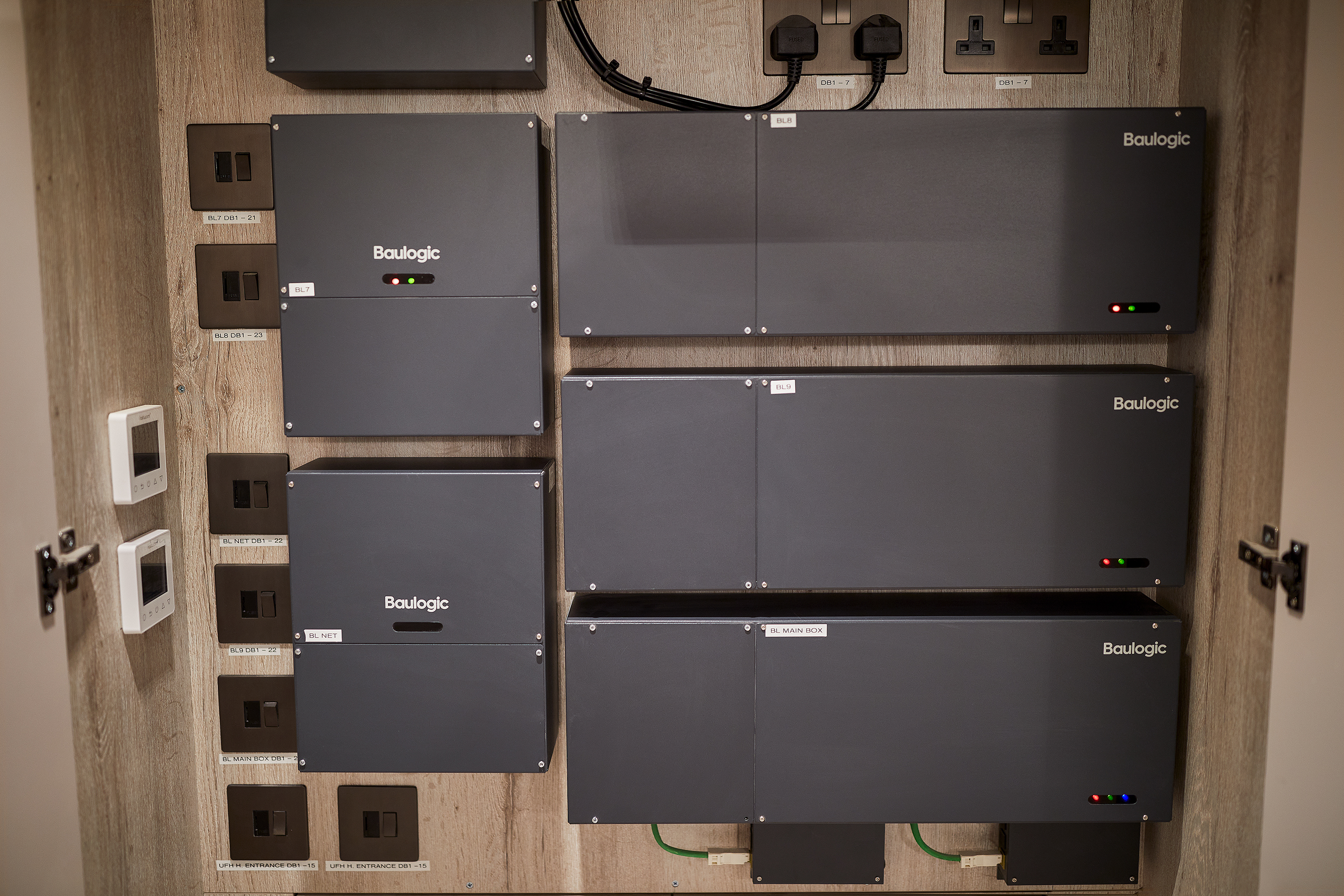
A hardwired system runs on dedicated cabling installed at first fix, with control logic that lives in the building rather than on a remote server. There is no router dependency and no cloud account that can lapse. For a developer handing over a home with a modelled A rating, this is the difference between a control system that holds up over a 10-year ownership period and one that quietly degrades after the first router change.
Pre-configured modular delivery matters for a related reason. Custom-programmed systems depend on the original integrator remaining available, willing, and contracted to make changes. When the homeowner wants to adjust a heating schedule or a lighting scene three years after handover, they should not need to call a specialist back to the property. A pre-configured modular system lets the homeowner adjust schedules, scenes, and zones themselves, which means the control logic stays useful rather than being abandoned the first time it needs a change.
For an electrician or M&E contractor, the practical point is that the system fits cleanly into a standard first and second fix without manufacturer-specific training or specialist commissioning. Wiring runs back to a central panel, the panel arrives configured, and the installation completes without a separate trade in the chain. There is no support liability sitting with the contractor after handover.
What to specify on a current project
For a developer working on a current scheme, the practical decisions sit at RIBA Stage 3 or 4, alongside the rest of the M&E specification.
Multi-zone heating control should be specified room by room or zone by zone, with the heat pump, underfloor heating manifold, and hot water cylinder integrated into the same logic. Single-zone or floor-level zoning is a missed opportunity on a home of this type.
DALI-2 lighting control should be specified as the backbone for fixed lighting, with daylight and presence detection in circulation spaces and external areas. The lighting design itself should support this, with circuits zoned for control rather than for switching simplicity.
External shading on south and west elevations should be motorised and integrated, particularly where Part O compliance is being demonstrated through shading rather than glazing changes.
PV, battery storage, and EV charging should all be specified with their integration paths to the control system identified. Most major equipment has a wired interface or a documented gateway, but this is worth confirming at specification stage rather than at commissioning.
Document the as-installed configuration in the handover pack. This makes any future changes simpler and gives the homeowner the information they need to keep the system working in line with its design intent.
EPC ratings on UK new builds reward the fabric first, the plant second, and the controls third. The controls are where the gap between modelled and in-use performance is closed, and they are where a hardwired, pre-configured home automation system earns its place on the M&E specification.
The practical decision on a current project is to bring the control specification into the same conversation as heating, lighting, ventilation, and renewables at RIBA Stage 3 or 4. Specify multi-zone heating control, DALI-2 lighting with daylight and presence detection, motorised external shading on solar-exposed elevations, and integrated control of PV, battery, and EV charging. Confirm that the system is hardwired, pre-configured, and installable by a competent electrician without specialist commissioning. Those decisions, made early, are what turn a modelled A rating into a home that actually performs at A in occupation.
More Insights