A developer planning a small UK housing scheme in 2026 has more decisions to make at first fix than at any point in the last decade. Heat pumps, MVHR, PV with battery storage, EV charging, and tightening Part L compliance are all moving from optional to expected on homes valued from £700,000 upwards.
Home automation sits inside that same first fix window. Specified early, a hardwired, pre-configured system fits into the standard electrical package without lengthening the programme. Specified late, or treated as a separate trade, it becomes a problem.
This guide is written for UK property developers and custom builders who want to understand what hardwired home automation actually adds to a development in 2026, how it interacts with energy performance, and where the practical pitfalls are.
What hardwired home automation is in 2026
Home automation is the integration of lighting, heating, cooling, blinds, security, and other building systems under a single control layer. Hardwired systems run that control over dedicated cabling installed at first fix, typically a bus cable such as KNX or a DALI lighting backbone, terminating at a central panel.
This is different from wireless or hub-based products that sit on top of a finished house and depend on WiFi, the cloud, or a proprietary radio mesh. Hardwired systems do not rely on a router being online or a manufacturer's cloud service staying in business. The control logic lives in the building.
Pre-configured platforms take this one step further. The control panel arrives on site with the logic already loaded, the modules already addressed, and the wiring topology already defined. A standard electrician installs it as part of the wider electrical package. There is no commissioning engineer waiting for second fix, and no specialist integrator returning for callbacks.
Why this matters to builders specifically
The case for home automation on premium and ultra-prime developments used to be a buyer appeal argument. In 2026 it is closer to a baseline expectation in the £700,000+ segment, and it has started to do real work on energy performance.
Three things have shifted.
First, buyers at this price point increasingly expect lighting, heating, and shading to be coordinated rather than controlled by separate thermostats and switches scattered through the house. A development that delivers this through a properly designed system is differentiated. One that bolts on a consumer-grade hub after handover is not.
Second, the M&E package on a premium new build now includes systems that benefit from integrated control. A heat pump, MVHR unit, underfloor heating manifold, and solar PV with battery storage all run more efficiently when they can see each other and respond to occupancy and external conditions. Without integration, each operates in isolation.
Third, the regulatory direction is towards measured performance. Future Homes Standard, ongoing changes to Part L, and the SAP 11 methodology are pushing developers towards demonstrable energy efficiency rather than design-stage estimates. Control plays a measurable role here.

Home automation and energy efficiency ratings
The honest position is this: home automation does not change the fabric of a building, and SAP currently gives limited explicit credit for control systems beyond specific items like heating controls and lighting efficacy. A poorly insulated house with excellent automation is still a poorly insulated house.
What automation does change is in-use performance, which is what the regulatory direction is moving towards.
A few practical examples on a typical premium new build.
Multi-zone heating control reduces wasted heat in unoccupied rooms. On a four-bedroom home with an air source heat pump and underfloor heating, room-by-room scheduling tied to actual occupancy patterns produces measurable reductions in heating demand compared to a single-zone or floor-level zoning approach.
Coordinated shading and lighting reduces overheating risk and electrical lighting load. Automated external shading on south and west elevations cuts solar gain during summer afternoons, which matters under Part O. Daylight-linked lighting reduces artificial lighting use during the day.
Integration with PV and battery storage allows loads to shift towards times of self-generation. A home with 8 kW of PV and a battery can be configured to run higher-load appliances and hot water cycles when self-generation is highest, increasing the proportion of generated electricity used on site rather than exported.
None of this is magic, and none of it removes the need for good fabric, good glazing, and properly specified plant. It does, however, mean that two homes built to the same SAP rating can perform meaningfully differently in occupation, and the one with integrated control will usually be the one that performs closer to its design intent.
Where it fits in the build programme
The single biggest practical issue with home automation on UK developments is timing. Specified at the wrong point, it becomes a separate workstream that fights the rest of the programme. Specified at the right point, it disappears into the electrical package.
For hardwired, pre-configured systems, the sequence is straightforward.
At RIBA Stage 3 or 4, the system is specified alongside the rest of the M&E. The control schedule for each home is agreed: which rooms have keypads, how lighting circuits are zoned, what heating zones are required, whether blinds are motorised, what security devices are integrated.
At first fix, the electrician runs the bus cabling and any DALI or low-voltage cabling alongside standard mains. The cable runs are not exotic; they are additional structured cabling routed back to the location of the control panel, typically in a plant room or utility cupboard.
The pre-configured panel arrives on site ready to install. It is mounted, the cables are terminated, and it is energised. There is no programming visit, no separate commissioning trade, and no waiting on a specialist integrator's calendar.
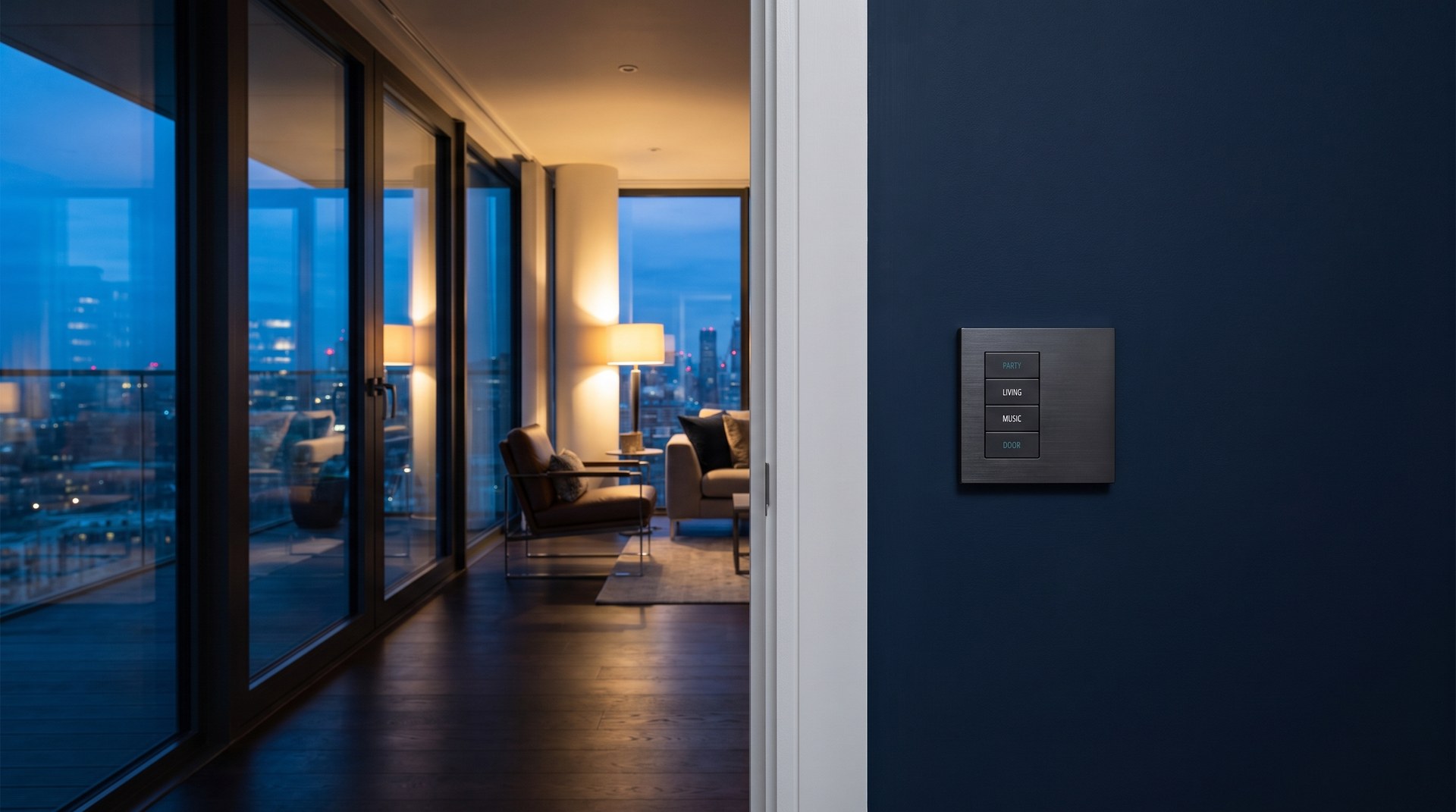
At second fix, keypads, sensors, and thermostats are installed in place of standard accessories. The same electrician completes this work.
The system is then tested and handed over. The homeowner can adjust scenes, schedules, and preferences through a wall panel or app without calling anyone back.
For a developer, the relevant point is that this fits the existing trade structure. There is no new subcontractor to manage, no separate retention, and no callback liability sitting with a third party after handover.
What changes for the electrician
Electricians and M&E contractors are the people who install this work, and their concerns are legitimate. Three questions come up repeatedly.
Does the system require manufacturer-specific training? For a pre-configured platform, no. The installation is wiring and termination work that any competent electrician can carry out. The configuration is done off-site before delivery.
Does it create support liability after handover? With a pre-configured modular system, no. The homeowner can adjust the system themselves through the standard interfaces. If a module fails, it is a like-for-like replacement, not a call-out to reprogram the building.
How does it sit alongside a standard 18th Edition installation? Cleanly. The bus cabling is additional, not a replacement for any part of the mains electrical installation. Circuit protection, earthing, and testing follow normal practice. The control system sits on top of, and alongside, a conventional installation.
For an M&E contractor pricing a job, this matters because it means the automation package can be priced and delivered without a specialist subcontractor in the chain.
Hardwired versus wireless and cloud-based alternatives
Most consumer-grade home automation in the UK is wireless and cloud-dependent. On a £350,000 home being retrofitted by its owner, that is a reasonable choice. On a £1.5M new build, it is the wrong specification for three reasons.
Reliability. WiFi networks are designed for data, not for control of building systems. A hardwired bus is deterministic. A WiFi mesh is not.
Longevity. Cloud-dependent products are tied to the manufacturer's service. When the service is discontinued or the manufacturer is acquired, the product can become unusable. Hardwired systems based on open protocols like KNX have a track record measured in decades.
Coverage and capacity. A premium new build can have 80 or more lighting circuits, 12 or more heating zones, and dozens of sensors and keypads. Wireless systems scale poorly at this density.
This is also where the comparison with established control brands sits. KNX, Crestron, Control4, Loxone, Lutron, and Rako are all credible hardwired platforms, with different trade-offs around openness, proprietary programming, and the level of specialist support required to install and maintain them. The structural question for a developer is not which logo goes on the panel, but whether the system can be specified, installed, and supported through the standard electrical package, or whether it requires a dedicated integrator on every project.
Practical specification points for 2026
A few things worth getting right at design stage on a UK development in 2026.
Specify the control system at the same time as the rest of the M&E, not after. The cabling decisions interact with the lighting design, the heating zoning, and the location of the consumer unit and plant.
Plan the location of the control panel early. It needs a dry, ventilated space with access for maintenance, typically a utility cupboard or plant room, not a loft.
Coordinate the lighting design with the control scheme. DALI-2 control of lighting is standard on this type of project in 2026, and it benefits from a lighting design that uses fewer, higher-quality fittings on properly zoned circuits rather than a high count of basic fittings on a small number of circuits.
Decide early which third-party systems integrate with the control layer. Heat pump, MVHR, PV inverter, battery, EV charger, and security all have different integration paths. Some are straightforward, others require specific gateways or wired interfaces.
Document the as-installed configuration as part of the handover pack. Homeowners on premium new builds increasingly expect this level of documentation, and it makes any future changes simpler.
For UK developers and custom builders working in the premium and ultra-prime segment in 2026, home automation is no longer an optional layer added at the end of a project. It is part of the M&E specification, and the decisions made about it at RIBA Stage 3 or 4 shape the programme, the cost, and the in-use performance of the finished home.
The practical next step on any current project is to bring the control specification forward into the same conversation as heating, lighting, ventilation, and renewables. Decide whether the system will be hardwired or wireless, pre-configured or custom-programmed, and electrician-installable or integrator-dependent, before first fix starts on site. Those three decisions, made early, determine almost everything else.
More Insights